

How To Draw 95 Confidence Interval
Confidence Intervals
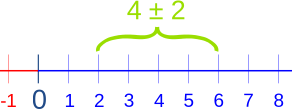
An interval of 4 plus or minus 2
A Conviction Interval is a range of values we are fairly certain our true value lies in.

Instance: Average Pinnacle
We measure the heights of 40 randomly called men, and get a mean height of 175cm,
We also know the standard deviation of men's heights is 20cm.
The 95% Confidence Interval (we testify how to calculate it later on) is:
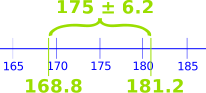
The "±" ways "plus or minus", so 175cm ± 6.2cm ways
- 175cm − 6.2cm = 168.8cm to
- 175cm + half dozen.2cm = 181.2cm
And our consequence says the true hateful of ALL men (if we could mensurate all their heights) is probable to be between 168.8cm and 181.2cm
But information technology might non exist!
The "95%" says that 95% of experiments similar we merely did volition include the true mean, but 5% won't.
So in that location is a 1-in-20 chance (5%) that our Confidence Interval does Not include the true hateful.
Calculating the Conviction Interval
Footstep ane: offset with
- the number of observations n
- the mean X
- and the standard divergence south
Note: we should use the standard deviation of the entire population, merely in many cases we won't know information technology.
We can use the standard deviation for the sample if nosotros accept enough observations (at least n=30, hopefully more than).
Using our case:
- number of observations n = 40
- mean 10 = 175
- standard deviation due south = 20
Step 2: make up one's mind what Confidence Interval we want: 95% or 99% are common choices. And so find the "Z" value for that Confidence Interval here:
| Confidence Interval | Z |
| lxxx% | 1.282 |
| 85% | one.440 |
| xc% | 1.645 |
| 95% | one.960 |
| 99% | 2.576 |
| 99.5% | 2.807 |
| 99.nine% | iii.291 |
For 95% the Z value is i.960
Pace iii: utilise that Z value in this formula for the Conviction Interval
Ten ± Z s √n
Where:
- 10 is the hateful
- Z is the chosen Z-value from the tabular array above
- s is the standard deviation
- n is the number of observations
And we have:
175 ± 1.960 × 20 √40
Which is:
175cm ± vi.20cm
In other words: from 168.8cm to 181.2cm
The value subsequently the ± is called the margin of error
The margin of error in our example is half dozen.20cm
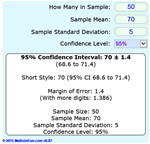
Reckoner
Nosotros have a Conviction Interval Estimator to make life easier for yous.
Simulator
We also have a very interesting Normal Distribution Simulator. where we can start with some theoretical "true" mean and standard deviation, and so take random samples.
Information technology helps united states of america to sympathise how random samples tin can sometimes be very good or bad at representing the underlying true values.
Another Example

Example: Apple Orchard
Are the apples big enough?
In that location are hundreds of apples on the copse, so you randomly choose only 46 apples and get:
- a Mean of 86
- a Standard Divergence of half-dozen.two
So let's calculate:
X ± Z s √northward
We know:
- X is the mean = 86
- Z is the Z-value = 1.960 (from the tabular array above for 95%)
- southward is the standard deviation = 6.2
- n is the number of observations = 46
86 ± one.960 × 6.2 √46 = 86 ± 1.79
So the true mean (of all the hundreds of apples) is likely to be between 84.21 and 87.79
Truthful Mean
At present imagine we become to pick ALL the apples straight abroad, and become them ALL measured past the packing machine (this is a luxury not unremarkably found in statistics!)
And the truthful mean turns out to be 84.9
Allow's lay all the apples on the ground from smallest to largest:
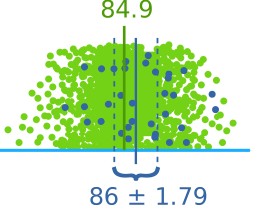
Each apple is a green dot,
our observations are marked blue
Our consequence was not exact ... information technology is random afterward all ... but the true mean is within our confidence interval of 86 ± 1.79 (in other words 84.21 to 87.79)
Now the true mean might non be within the conviction interval, but in 95% of the cases it will be!
95% of all "95% Conviction Intervals" will include the true mean.
Perhaps we had this sample, with a hateful of 83.v:
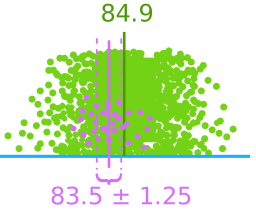
Each apple is a green dot,
our observations are marked regal
That does not include the truthful mean. That can happen about five% of the time for a 95% confidence interval.
Then how do nosotros know if our sample is one of the "lucky" 95% or the unlucky 5%? Unless we get to measure the whole population like above we simply don't know.
This is the risk in sampling, we might have a "bad" sample.
Case in Research
Here is Confidence Interval used in actual inquiry on extra exercise for older people:

What is it proverb? Looking at the "Male" line we see:
- 1,226 Men (47.6% of all people)
- had a "HR" (see below) with a mean of 0.92,
- and a 95% Confidence Interval (95% CI) of 0.88 to 0.97 (which is also 0.92±0.05)
"HR" is a measure of health benefit (lower is better), so it says that the truthful do good of exercise for the wider population of men has a 95% hazard of being between 0.88 and 0.97
* Annotation for the curious: "HR" is used a lot in health research and means "Adventure Ratio" where lower is better. So an Hr of 0.92 ways the subjects were better off, and a 1.03 ways slightly worse off.
Standard Normal Distribution
Information technology is all based on the thought of the Standard Normal Distribution, where the Z value is the "Z-score"
For case the Z for 95% is 1.960, and here we see the range from -1.96 to +1.96 includes 95% of all values:
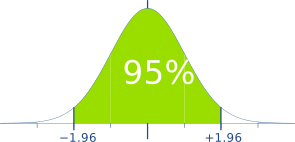
From -i.96 to +1.96 standard deviations is 95%
Applying that to our sample looks like this:
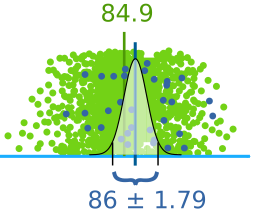
Also from -1.96 to +1.96 standard deviations, then includes 95%
Conclusion
The Confidence Interval is based on Mean and Standard Divergence. Its formula is:
X ± Z due south √n
Where:
- X is the mean
- Z is the Z-value from the table beneath
- s is the standard deviation
- n is the number of observations
| Confidence Interval | Z |
| 80% | i.282 |
| 85% | 1.440 |
| 90% | one.645 |
| 95% | 1.960 |
| 99% | 2.576 |
| 99.five% | 2.807 |
| 99.9% | 3.291 |
11285, 11286, 11287, 11288, 11289, 11290, 11291, 11292

Source: https://www.mathsisfun.com/data/confidence-interval.html
Posted by: gonzalezwhoustinity.blogspot.com
0 Response to "How To Draw 95 Confidence Interval"
Post a Comment