

What Is The Makeup Of The French Parliament In The Medival Kingdoms?
| French Parliament Parlement français | |
|---|---|
| 15th Legislature of the French Fifth Republic | |
 Emblem of the French Commonwealth | |
| Type | |
| Type | Bicameral |
| Houses | Senate National Associates |
| Leadership | |
| President of the Senate | Gérard Larcher, LR |
| President of the National Assembly | Richard Ferrand, REM |
| Construction | |
| Seats | Senate: 348 National Associates: 577 |
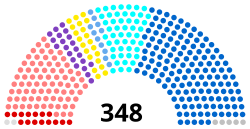 | |
| Senate political groups |
|
 | |
| National Associates political groups |
|
| Elections | |
| Senate voting system | Indirect election |
| National Assembly voting system | First-past-the-mail voting (577 seats, two-round system) |
| Senate last election | 27 September 2020 |
| National Assembly concluding election | xi and eighteen June 2017 |
| Senate next election | By September 2023 |
| National Assembly next ballot | By June 2022 |
| Meeting identify | |
 | |
| Aile du Midi, Château de Versailles | |
| Website | |
| parlement.fr | |

The French Parliament (French: Parlement français) is the bicameral legislature of the French Republic, consisting of the Senate ( Sénat ) and the National Assembly ( Assemblée nationale ). Each associates conducts legislative sessions at divide locations in Paris: the Senate meets in the Palais du Luxembourg and the National Assembly convenes at Palais Bourbon .
Each business firm has its own regulations and rules of procedure. However, occasionally they may meet as a single house known as the Congress of the French Parliament ( Congrès du Parlement français ), convened at the Palace of Versailles, to revise and amend the Constitution of France.
Scope of article [edit]
The French Parliament, as a legislative body, should non be dislocated with the diverse parlements of the Ancien Régime in French republic, which were courts of justice and tribunals with sure political functions varying from province to province and as to whether the local police force was written and Roman, or customary common police.
The word "Parliament", in the modern meaning of the term, appeared in French republic in the 19th century, at the time of the constitutional monarchy of 1830–1848. Information technology is never mentioned in whatsoever ramble text until the Constitution of the 4th Democracy in 1948. Before that time, reference was made to "les Chambres" or to each associates, any its name, but never to a generic term every bit in United kingdom. Its grade – unicameral, bicameral, or multicameral – and its functions have varied throughout the different political regimes and according to the diverse French constitutions:
| Engagement | Constitution | Upper chamber | Lower chamber | Other bedchamber | Joint sitting | Single chamber |
|---|---|---|---|---|---|---|
| 1791 | French Constitution of 1791 | Assemblée Nationale | ||||
| 1793 | French Constitution of 1793 | Corps législatif | ||||
| 1795–1799 | Constitution of the Year III | Conseil des Anciens | Conseil des Cinq-Cents | |||
| 1799–1802 | Constitution of the Year Viii | Sénat conservateur | Corps législatif | Tribunat | ||
| 1802–1804 | Constitution of the Year X | Sénat conservateur | Corps législatif | Tribunat | ||
| 1804–1814 | Constitution of the Year XII | Sénat conservateur | Corps législatif | Tribunat[Note 1] | ||
| 1814–1815 | Charter of 1814 | Chamber of Peers | Chambre des députés des départements | |||
| 1815 | Additional Act to the Constitutions of the Empire | Sleeping room of Peers | Sleeping room of Representatives | |||
| 1830–1848 | Charter of 1830 | Bedroom of Peers | Chamber of Deputies | |||
| 1848–1852 | French Constitution of 1848 | Assemblée Nationale | ||||
| 1852–1870 | French Constitution of 1852 | Sénat | Corps législatif | |||
| 1871–1875 | Assemblée Nationale | |||||
| 1875–1940 | French Constitutional Laws of 1875 | Sénat | Chamber of Deputies | Assemblée Nationale | ||
| 1940–1944 | French Constitutional Constabulary of 1940 | |||||
| 1944–1946 | Provisional Authorities of the French Republic | Assemblée Nationale | ||||
| 1946–1958 | French Constitution of 1946 | Conseil de la République | Assemblée Nationale | Parliament | ||
| since 1958 | French Constitution of 1958 | Sénat | Assemblée Nationale | Parlement réuni en Congrès |
Election of representatives [edit]
The electric current Parliament is composed of 2 chambers: the upper Senate (French: le Sénat) and the lower National Assembly, which take 349 and 577 members respectively.
Deputies, who sit down in the National Assembly, are elected by first past the post voting in two rounds for a term of five years, still a dissolution of the Assembly. Each constituency has around 100,000 residents, though some variance of size exists between rural and urban constituencies. For example, the Val-d'Oise constituency has 188,000 electors, while Lozère has just 34,000.[1]
Senators are elected by indirect universal suffrage by the grands électeurs, who consist of deputies, regional councillors, departmental councillors and representatives of municipal councillors. The latter establish 95% of the electoral body.
Organisation and powers [edit]
Ordinarily, the parliament meets for a unmarried 9-month session each year only under special circumstances the President of France can call an additional session. Parliamentary ability was limited afterwards the establishment of the Fourth Republic; still, the National Assembly can still cause a government to autumn if an absolute majority of the legislators votes for a motility of no conviction. Every bit a result, the authorities usually consists of members from the political political party that dominates the Assembly and must be supported by a majority there to prevent a vote of no-confidence.
The Prime number Minister and other government Ministers are appointed past the President, who is under no constitutional or other mandatory obligation to make governmental appointments from the ranks of the majority party in parliament. This is a safety-guard that was introduced by the founder of the Fifth Democracy, Charles de Gaulle, to attempt to prevent the disarray and horse-trading seen in the parliamentary regimes of the Tertiary and Fourth Republics; however, in do the prime minister and other ministers commonly do vest to the majority party. A notable exception to this custom occurred during Nicolas Sarkozy's premiership when he appointed socialist ministers and Secretary of State-level junior ministers to his regime. The rare periods during which the president is non from the aforementioned political political party equally the prime number minister are normally known equally cohabitation. The Chiffonier of Ministers is led by the President rather than the Prime Government minister.
The government (or, when it sits in session every Wednesday, the cabinet) exerts considerable influence on the calendar of Parliament. The regime likewise can link its term to a legislative text which information technology proposes, and unless a movement of censure is introduced within 24 hours of the proposal and passed inside 48 hours of introduction – thus full procedures last at most 72 hours – the text is considered adopted without a vote. However, this procedure was limited by a 2008 constitutional amendment. Legislative initiative rests with the National Associates.
Legislators relish parliamentary immunity.[2] Both assemblies have committees that write reports on a variety of topics. If necessary, they can establish parliamentary commissions of inquiry with wide investigative ability. Yet, this is almost never exercised because the majority can reject a proposition by the opposition to create an investigatory commission. Also, such a committee may only be created if it does not interfere with a judicial investigation, meaning that in club to cancel its creation, one simply needs to press charges on the topic concerned by the investigatory commission. Since 2008, the opposition may impose the creation of an investigative commission one time a yr, even against the wishes of the majority. Still, they still cannot lead investigations if there is a judicial case in process already (or that starts after the committee is formed).
List [edit]
Encounter also [edit]
- Constitution of France
- Government of France
- History of France
- Politics of French republic
- Member of Parliament (France)
- List of French legislatures
Notes [edit]
- ^ The Tribunate was abolished past a decree of the Senate in 1807, with its remaining functions and members absorbed into the Corps législatif.
References [edit]
- ^ Source in French: Stéphane Mandard (2007) Un rapport préconisait le remodelage des circonscriptions avant les législatives de 2007, Le Monde. seven juin 2007.
- ^ In French republic, for most a century, commodity 121 of the Penal Code punished with civic degradation all police officers, all prosecutors and all judges if they had caused, issued or signed a judgment, an gild or a warrant, disposed to a personal process or an accusation against a member of the Senate or of the legislative body, without the authorization prescribed past the Constitutions: Buonomo, Giampiero (2014). "Immunità parlamentari: Why not?". 50'Ago eastward Il Filo. Archived from the original on 11 Dec 2019. Retrieved 12 Apr 2016.
- This commodity is based mainly on the article Parlement français from the French Wikipedia, Retrieved thirteen October 2006.
Further reading [edit]
- Frank R. Baumgartner, "Parliament'due south Chapters to Expand Political Controversy in France", Legislative Studies Quarterly, Vol. 12, No. 1 (Feb. 1987), pp. 33–54. JSTOR: 440044
- Marc Abélès, Un ethnologue à l'Assemblée. Paris: Odile Jacob, 2000. An anthropological written report of the French National Assembly, of its personnel, lawmakers, codes of behaviors and rites.
External links [edit]
- Official website
 (in French)
 - Site of the CHPP (Comité d'histoire parlementaire et politique) and of Parlement(s), Revue d'histoire politique (in French)
Source: https://en.wikipedia.org/wiki/French_Parliament
Posted by: gonzalezwhoustinity.blogspot.com
0 Response to "What Is The Makeup Of The French Parliament In The Medival Kingdoms?"
Post a Comment