

What Conclusions About British Rule Does Jefferson Draw From The Evidence He Presents?
Thomas Jefferson is considered the principal author of the Proclamation of Independence, although Jefferson'southward typhoon went through a process of revision by his young man committee members and the 2d Continental Congress.
How the Announcement Came About
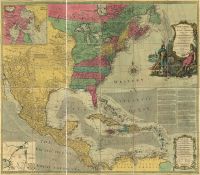 Map of the British Colonies in Northward America in 1763
America'southward declaration of independence from the British Empire was the nation's founding moment. Simply it was not inevitable. Until the spring of 1776, most colonists believed that the British Empire offered its citizens freedom and provided them protection and opportunity. The female parent country purchased colonists' goods, dedicated them from Native American Indian and European aggressors, and extended British rights and freedom to colonists. In return, colonists traded primarily with Britain, obeyed British laws and customs, and pledged their loyalty to the British crown. For well-nigh of the eighteenth century, the relationship between Great britain and her American colonies was mutually benign. Even as tardily as June 1775, Thomas Jefferson said that he would "rather be in dependence on United kingdom of great britain and northern ireland, properly limited, than on whatsoever nation upon earth, or than on no nation."[i]
But this favorable human relationship began to face serious challenges in the wake of the Vii Years' State of war. In that conflict with France, Britain incurred an enormous debt and looked to its American colonies to help pay for the war. Betwixt 1756 and 1776, Parliament issued a serial of taxes on the colonies, including the Stamp Human action of 1765, the Townshend Duties of 1766, and the Tea Act of 1773. Even when the taxes were relatively light, they met with strong colonial resistance on principle, with colonists concerned that "taxation without representation" was tyranny and political control of the colonies was increasingly being exercised from London. Colonists felt that they were existence treated as 2nd-class citizens. But subsequently initially compromising on the Stamp Act, Parliament supported increasingly oppressive measures to force colonists to obey the new laws. Somewhen, tensions culminated in the shots fired between British troops and colonial militia at Lexington and Agree on April 19, 1775.
 Play
Play 1 of ii
The Legacy of the Declaration
 Play
Play two of 2
The story backside the signing of the Declaration of Independence
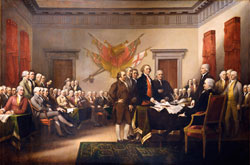 The Declaration of Independence by John Trumbull; image courtesy Architect of the Capitol
Despite the outbreak of violence, the majority of colonists wanted to remain British. Only when King George Three failed to address colonists' complaints against Parliament or entertain their appeals for compromise did colonists brainstorm to consider independence as a last resort. Encouraged by Thomas Paine'southward pamphlet, "Mutual Sense," more and more than colonists began to consider independence in the leap of 1776. At the same time, the continuing war and rumors of a big-scale invasion of British troops and German mercenaries diminished hopes for reconciliation.
While the event had been discussed quietly in the corridors of the Continental Congress for some time, the first formal proposal for independence was not made in the Continental Congress until June vii, 1776. Information technology came from the Virginian Richard Henry Lee, who offered a resolution insisting that "all political connectedness is, and ought to be, dissolved" between Great Uk and the American colonies.[two] But this was not a unanimous sentiment. Many delegates wanted to defer a conclusion on independence or avoid it outright. Despite this disagreement, Congress did nominate a drafting committee—the Committee of Five (John Adams, Benjamin Franklin, Thomas Jefferson, Robert Livingston, and Roger Sherman)—to compose a declaration of independence. Thomas Jefferson, known for his eloquent writing fashion and reserved mode, became the main author.
 Rough Draft of the Announcement
As he sat at his desk in a Philadelphia boarding business firm, Jefferson drafted a "mutual sense" treatise in "terms and then plain and firm, every bit to command [the] assent" of mankind.[3] Some of his language and many of his ideas drew from well-known political works, such as George Mason'southward Declaration of Rights. But his ultimate goal was to limited the unity of Americans—what he chosen an "expression of the american heed"—against the tyranny of Uk.[iv]
Jefferson submitted his "rough draught" of the Annunciation on June 28. Congress eventually accepted the certificate, only not without debating the draft for two days and making extensive changes. Jefferson was unhappy with many of the revisions—peculiarly the removal of the passage on the slave merchandise and the insertion of language less offensive to Britons—and in later years would often provide his original draft to correspondents. Benjamin Franklin tried to reassure Jefferson by telling him the now-famous tale of a merchant whose storefront sign bore the words: "John Thompson, Hatter, makes and sells hats for ready money;" after a circle of critical friends offered their critiques, the sign merely read, "John Thompson" in a higher place a moving-picture show of a chapeau. [5]
Pressured by the news that a fleet of British troops lay off the declension of New York, Congress adopted the Lee resolution of independence on July second, the day which John Adams always believed should be celebrated as American independence twenty-four hour period, and adopted the Declaration of Independence explaining its action on July iv.
The Declaration was promptly published, and throughout July and August, it was spread by give-and-take of mouth, delivered on horseback and by ship, read aloud before troops in the Continental Regular army, published in newspapers from Vermont to Georgia, and dispatched to Europe. The Declaration roused back up for the American Revolution and mobilized resistance against United kingdom at a fourth dimension when the war endeavor was going poorly.
The Declaration provides articulate and emphatic statements supporting self-authorities and individual rights, and it has become a model of such statements for several hundred years and around the globe.
Read next:
- Printing and Signing the Announcement »
- The Legacy of the Declaration »
Further Sources
- Allen, Danielle Southward. Our Declaration: A Reading of the Declaration of Independence in Defense of Equality. New York: Liveright Publishing, 2014.
- Armitage, David. The Declaration of Independence: A Global History. Cambridge, Mass.: Harvard University Printing, 2007. An examination of the Declaration of Independence from a global perspective.
- Boyd, Julian P. The Proclamation of Independence: The Evolution of the Text. Issued in conjunction with an exhibit of these drafts at the Library of Congress on the 2 hundredth anniversary of the birth of Thomas Jefferson. Washington: Library of Congress, 1943. Reprinted 1945, 1999. Contains facsimiles of the known extant drafts of the Annunciation.
- Colonial Williamsburg Foundation. Principles of Freedom: The Declaration of Independence and the American Revolution. This extensive site includes an excellent timeline of the cosmos and signing of the Declaration.
- DuPont, Christian Y. and Peter South. Onuf, eds. Declaring Independence: The Origin and Influence of America'south Founding Document: Featuring the Albert H. Modest Annunciation of Independence Collection. Charlottesville, Va.: Academy of Virginia Library, 2008.
- Ellis, Joseph J., ed. What Did the Declaration Declare? Boston: Bedford/St. Martin's, 1999.
- Gerber, Scott Douglas. The Declaration of Independence: Origins and Impact. Washington, D.C.: CQ Press, 2002. A useful book discussing documents which influenced the Declaration, and also other documents influenced by the Proclamation.
- Hazelton, John H. The Declaration of Independence: Its History. New York: Dodd, Mead, & Co., 1906. Reprinted 1970 past Da Capo Press. In-depth await at the cosmos of the Announcement of Independence. An appendix contains transcriptions of contemporary letters and annotations on the diverse drafts and changes to the Declaration.
- Maier, Pauline. American Scripture: Making the Declaration of Independence. New York: Knopf, 1997. An excellent scholarly overview of the cosmos of the Annunciation.
- National Archives. America's Founding Documents. "The Announcement of Independence." The National Athenaeum presents a rich fix of material on the Declaration, including transcripts and manufactures on the creation and history of the Declaration.
- Milestone Documents In The National Archives. The Announcement of Independence. National Athenaeum and Records Administration, Washington, D.C., 1992. Focuses on the history of the engrossed parchment later on 1776.
- The Declaration of Independence read by Bill Barker, who interprets Thomas Jefferson for Colonial Williamsburg
- Thomas Jefferson Foundation. The Monticello Classroom. "Jefferson and the Declaration of Independence". An article written for uncomplicated- and middle-schoolhouse-level readers.
- Wait for more sources in the Thomas Jefferson Portal on the Declaration of Independence
one. Thomas Jefferson to John Randolph, August 25, 1775. Transcription available at Founders Online.
2. Journals of the Continental Congress, 1774-1789, ed. Worthington C. Ford et al. (Washington, D.C., 1904-37), 5:425.
3. Thomas Jefferson to Henry Lee, May eight, 1825.Transcription available at Founders Online.
five. Enclosure with Jefferson to Robert Walsh, Dec 4, 1818, in Ford x:120n.

What Conclusions About British Rule Does Jefferson Draw From The Evidence He Presents?,
Source: https://www.monticello.org/thomas-jefferson/jefferson-s-three-greatest-achievements/the-declaration/jefferson-and-the-declaration/
Posted by: gonzalezwhoustinity.blogspot.com
0 Response to "What Conclusions About British Rule Does Jefferson Draw From The Evidence He Presents?"
Post a Comment